
Penn at the International Neuropsychological Society Meeting
Updated: Jul 22
Researchers from the Penn FTD Center attended the International Neuropsychological Society (INS) meeting in February 2026 and we are excited to share news from this conference.
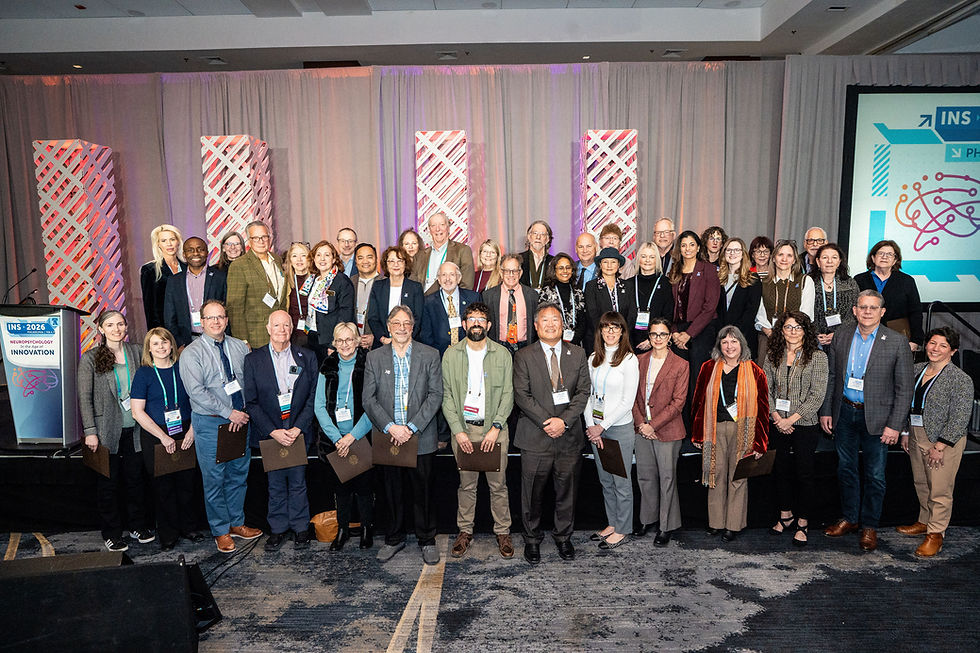
Emma Rhodes, PhD, Penn FTD Center’s Neuropsychologist & Assistant Professor has been inducted to the INS their inaugural class of fellows. The fellowship honors members of the INS who have demonstrated meaningful and sustained contributions to the society over time. Dr. Rhodes is recognized for her excellence in leadership roles, scholarly activities, and other significant forms of engagement.
Dr. Rhodes also presented a poster in collaboration with doctoral student Lauren Fisher, BSN, RN titled "Evaluating novel measures of empathy loss in behavioral variant frontotemporal dementia.” This poster assessed empathy loss in bvFTD. Overall, they found evidence that updated informant-report questionnaires could be more useful in improving measurement of empathy loss in bvFTD than computerized testing. This is important because empathy loss is often one of the earliest symptoms of bvFTD and more precise measurement could improve early diagnosis.
Ailey Gee, an undergraduate student under the supervision of Penn FTD Center Co-Director Lauren Massimo, PhD and Postdoctoral Fellow Rory Boyle, PhD, presented findings which linked increased exposure to fine inhalable particles in the air with faster decline in executive function in FTD. Executive function is one of the key cognitive abilities often affected in FTD and is a set of cognitive skills that we rely on to plan, make decisions, and manage everyday tasks. This work highlights that our physical environment may contribute to differential outcomes in FTD.
Penn FTD Center Clinical Research Coordinator Riya Chaturvedi presented a poster at INS which examined the association between everyday functioning and episodic memory. Everyday functioning was assessed by performance-based measures and the findings suggested that visual and verbal memory assessments can be used interchangeably to understand everyday functioning.

